Foto Project

Project

“COLLOC” stands for “Collaborative Production of Transformation Knowledge in Self-Organized Occupations”

The COLLOC 2024 Alumni Workshop is part of the collaborative “COLLOC Workshop Series”, which aims for the production of transformation knowledge. This kind of knowledge is made possible through the participation of many stakeholders, such as local actors and students. This collaboration structurally anchors an expansion of transdisciplinary cooperation and research in connection with teaching.

Alumni will have the opportunity to learn and share their expertise on a concrete social problem in a local context as they practice, test and reflect on mutual learning, transdisciplinary work with various actors from science and society.
program-01
program-02
program-03
Imagem Grafismo

The Alumni Workshop takes place in three phases

1

Preparation and defining the problem

Lorem ipsum dolor sit amet, consectetur adipiscing elit, sed do eiusmod tempor incididunt ut labore et dolore magna aliqua. Quis ipsum suspendisse ultrices gravida. Risus commodo viverra maecenas accumsan lacus vel facilisis.
2

Knowledge Integration and Development

Lorem ipsum dolor sit amet, consectetur adipiscing elit, sed do eiusmod tempor incididunt ut labore et dolore magna aliqua. Quis ipsum suspendisse ultrices gravida. Risus commodo viverra maecenas accumsan lacus vel facilisis.
3

Reflection and evaluation of transformation knowledge

Lorem ipsum dolor sit amet, consectetur adipiscing elit, sed do eiusmod tempor incididunt ut labore et dolore magna aliqua. Quis ipsum suspendisse ultrices gravida. Risus commodo viverra maecenas accumsan lacus vel facilisis.
Grafismo destaque Together, we will design context-appropriate interventions and reflect on their impact in the future development of the self-organised occupation of Solano Trindade.

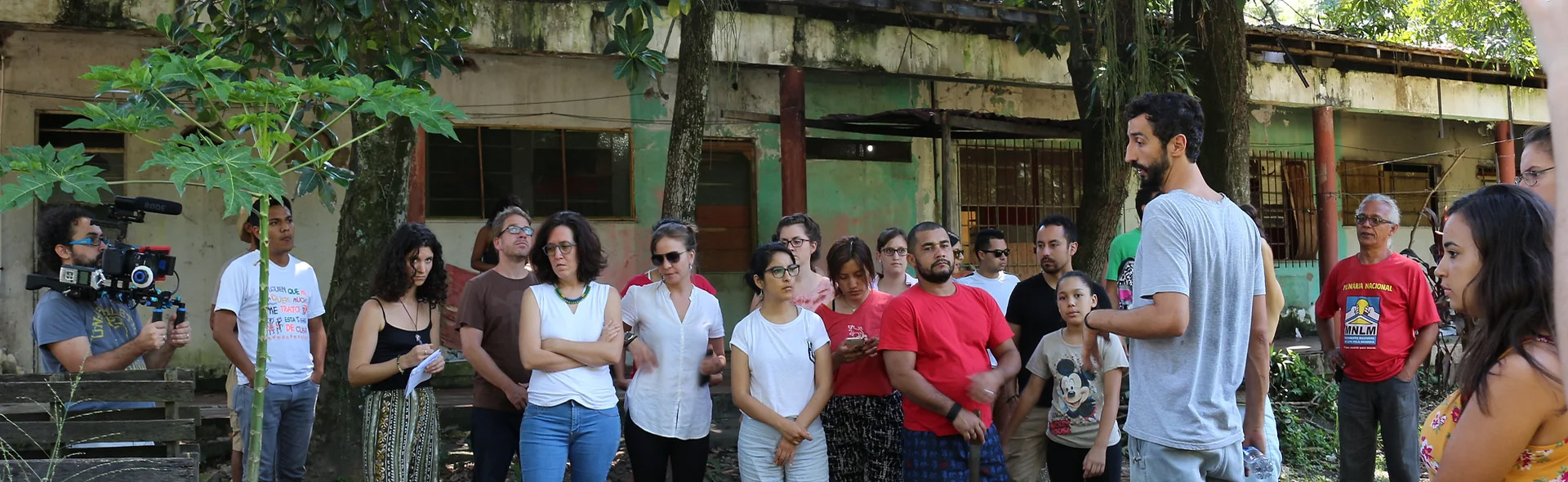
The phases follow a transdisciplinary process design and include the following: Methodologically, appropriate tools are planned for the three project phases that will enable permanent participation in the entire workshop process as well as further training for transdisciplinary research and networking. The workshop will focus on the self-organised occupation of Solano Trindade in Duque de Caxias, Brazil. By working closely together with community leaders, activists, residents, practitioners, academics, and students, the workshop will address the need for integrating knowledge coming from various actors and disciplines in order to tackle complex urban development challenges in a more suitable and innovative way.
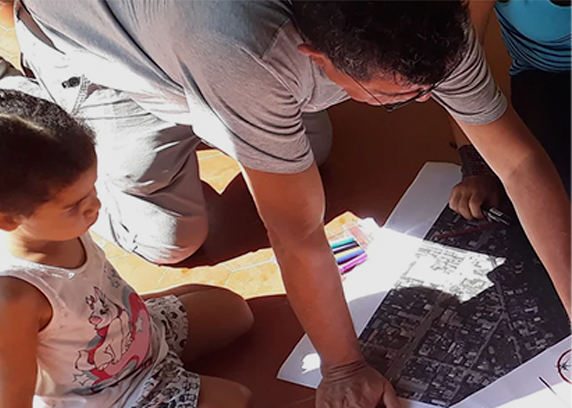
During the workshop participants are expected to

Grafismo During image-during
  • combine and integrate their practical expertise with local expertise from academics, dwellers, and students,
  • support the on-going projects as means for knowledge exchange and knowledge production,
  • collaboratively design future scenarios for the further development of the focus area,
  • arrive at local “problem-solutions” through the implementation of systemic design principles and transdisciplinary approaches, and
  • develop ideas to materialize co-produced knowledge in 1:1 interventions to be built collectively in place with students and local actors as a design-build project.

Workshop objectives

ico-workshop-01
The participants will expand their knowledge networks.
ico-workshop-02
The participants will acquire expertise in planning with hybrid formats.
ico-workshop-03
The participants will learn to develop solutions for a local context based on the integration of multiple knowledge bases from global contexts and mutual learning environments.
ico-workshop-04
The participants will learn about transdisciplinarity as a mode of research and collaborative knowledge production. They will test and reflect on both with a practical project/experiment in the real-world (transdisciplinary format).
ico-workshop-05
The participants will contribute to the development of a local community through built interventions and future scenarios and therefore co-produce of knowledge within complex social and natural networks.
ico-workshop-06
The participants will learn about online tools for collaboration and transdisciplinary research and how to use them in multi-stakeholder development projects.

Who can apply?

  • Alumni of German institutions of higher education and/or research residing in any DAC Country.
  • Working in the fields of urban development, architecture, landscape architecture, urban design, engineering, environmental planning, environmental technology, sociology, geography, and other relevant disciplines,
  • Preferably, participants hold positions in science, politics, NGOs, and have influential and/or decision-making experience in community work.
  • Experiences in the fields of urban informality, self-organization, development programs, food security, waste management systems are a plus but not required. The participants will be involved in a collaborative design and build process for 1:1 scale interventions. Skills in building crafts are of advantage but not essential.
Grafismo destaque The willingness to work in a team is a precondition
Application deadline 10 Oct Apply now

To apply, please fill in the application form and attach the required documents. One of the required application documents is a short description of your expertise. For that, please fill in this template. Instructions on how to do so can be found here.

PROGRAM 2024

Participation in this workshop is free of charge.
Local costs for accommodation, transport to Solano Trindade and occasional group meals will be funded.

Phase 1

Preparation and defining the problem 1

MON, 18 Oct

Opening, introduction and learning from each other (max. 4h)

TUE, 19 Oct

Learning about the space, development, problems and actors (4h)

20 Oct

Theoretical and collaborative methodological approaches (4h)

Phase 2

Knowledge Integration and Development 2

15 Nov

Introduction and Opening Ceremony + hands-on work on site (max. 4h)

16 - 22 Nov

Development of hands-on work on site + development of future scenarios

23 Nov

Final implementation of interventions + connection to scenarios + closing joint even

Phase 3

Reflection and evaluation of transformation knowledge 3

24 Nov

Reflection on the impact and future challenges + feedback/evaluation of the workshop

Phase 4

Teste 4

29 Mar

Reflection on the impact and future challenges + feedback/evaluation of the workshop